A Boost Surfing Story
Back to
the Lineup
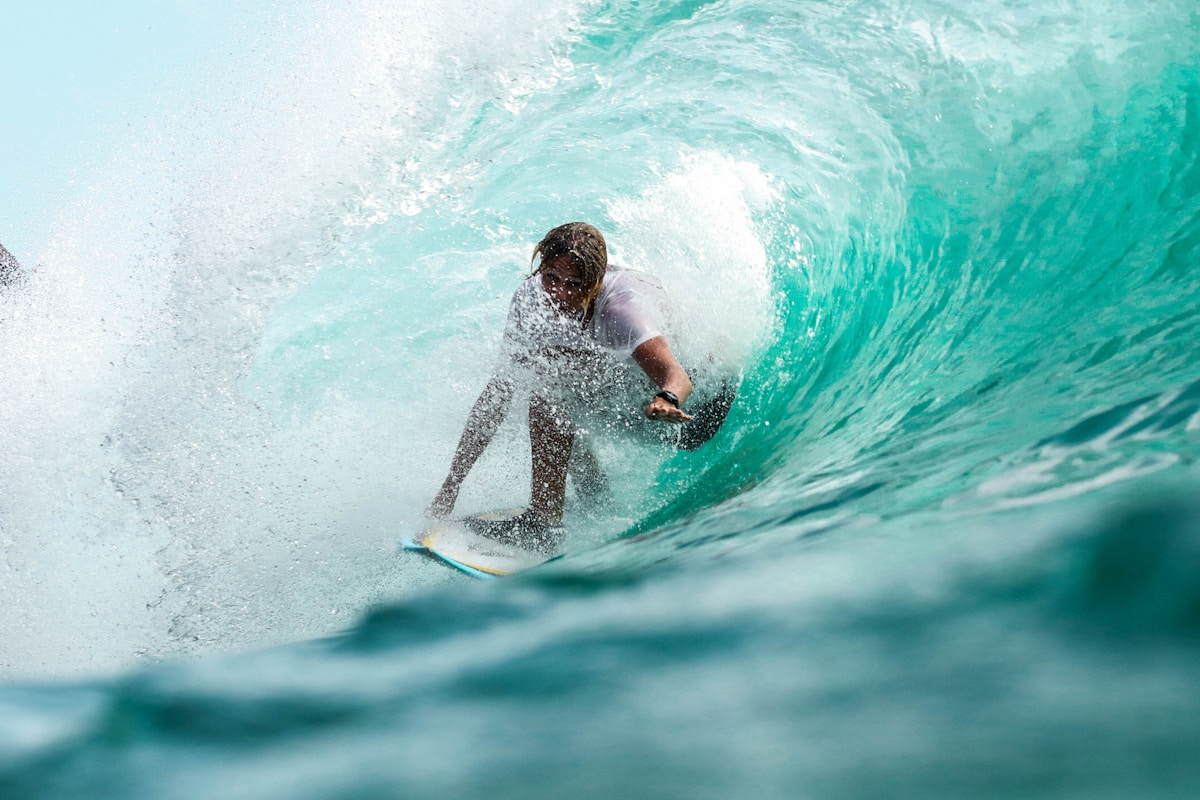
After rotator cuff surgery ended his 18-year surf career, Tom Brennan spent 14 months watching waves from the parking lot. This is the story of how he got back.
Chapter One
Tom Brennan started surfing at nineteen. Not because anyone taught him — his family was from Phoenix, desert people who drove to the coast twice a year if they were lucky. He taught himself on a waterlogged board he found in a garage sale for forty dollars.
By twenty-five, he was in San Diego. By twenty-seven, he was surfing every morning before his shift at the architecture firm. Dawn patrol at Tourmaline, usually by 5:45. The same spot, the same salt-crusted parking lot, the same nod to the regulars.
"Surfing wasn't a hobby," he says. "It was the thing that organized my day. The alarm went off at 5:15 and I never hit snooze. Not once in eighteen years. You don't snooze on a good swell."
He surfed through two job changes, a divorce, his mother's illness, and a cross-country move back to California. The board was the one constant. His therapist once told him that surfing was his "regulation mechanism." He didn't disagree.
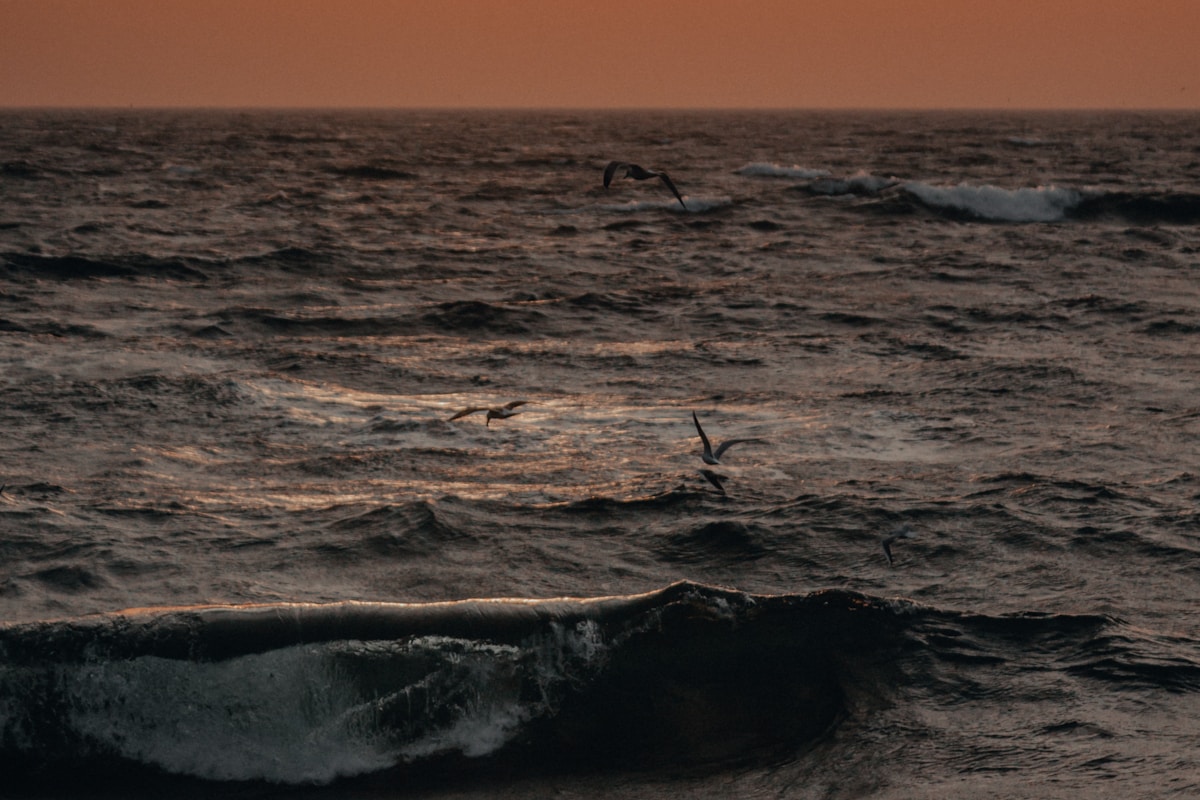
Tourmaline Beach, San Diego. Tom's morning spot for 12 years.
Chapter Two
It happened on a Tuesday. March 14th, 2024. He remembers the date because it was his daughter's birthday, and he'd promised to be home by 7:30 for pancakes.
"I was paddling out through a set. Nothing unusual. But my right arm just... stopped working. Mid-stroke. Like someone pulled the plug. I felt something tear — not sharp, more like a slow rip. Like fabric."
He made it to shore using his left arm. Drove home one-handed. Made the pancakes. Didn't mention the shoulder until his daughter left for school.
The MRI showed a full-thickness rotator cuff tear. His orthopedic surgeon, Dr. Kessler, was straightforward. Surgery, followed by six months of physical therapy. No overhead movements for four months. No surfing for at least eight.
"Your shoulder isn't what it used to be. Surfing is probably behind you. At your age, I'd find something lower-impact."
— Dr. Richard Kessler, Orthopedic Surgeon
Tom was thirty-seven. He didn't feel old. But in the surgeon's office, under fluorescent lights, looking at the gray smear on the MRI screen, he felt old for the first time.
Chapter Three
Surgery was April 9th. The first two weeks were the worst — sleeping upright in a recliner, arm in a sling, ice machine humming through the night. His daughter made him a card that said "Get Well Soon Daddy" with a drawing of him on a surfboard. He put it on the fridge. It stayed there for fourteen months.
Physical therapy started in May. Twice a week at a clinic in Kearny Mesa that smelled like disinfectant and rubber bands. The exercises were humiliating. Lifting a two-pound weight. Rotating his wrist. Reaching for a shelf. Things his body used to do without thinking now required concentration, repetition, and a timer.
He stopped going to the beach.
"I tried, once. About three months after surgery. I drove to Tourmaline at 5:30, sat in the parking lot, and watched the guys paddle out. My guys — the regulars. Mike, Carlos, that older guy everyone calls Bones. They were out there. I was in a Honda Civic with a sling on."
He pauses.
"I cried. In the car. At 5:45 in the morning. And then I drove home and told my daughter I'd been to the grocery store."
March 2024
Injury during morning surf. Full-thickness rotator cuff tear.
April 2024
Arthroscopic surgery. Six anchors. Two tendons reattached.
May–October
Physical therapy. Twice weekly. Slow, painful progress.
November 2024
Cleared for "light activity." Doctor advises against surfing.
December–April 2025
Depression. Stops visiting the beach. Board stays in garage.
Chapter Four
It was Carlos who mentioned it. May 2025. They ran into each other at a taco shop in Pacific Beach — the kind of place where the floors are sticky and the fish tacos are perfect.
"He said, 'Bro, you seen these electric fins? There's this guy at La Jolla Shores who has one. He's like sixty. Bad knees. And he's out there every morning. The fin does the paddling for him.'"
Tom went home and Googled it. Found the Boost Fin Plus. An electric fin with a folding propeller that slides into a standard fin box. Waterproof remote. 100-minute battery. Removes up to 90% of paddle strain.
"I was skeptical," he says. "I've been surfing for almost twenty years. Purist mentality. You paddle out under your own power or you don't go out. That's how I was raised in the water."
He watched every YouTube video he could find. Read forum threads. Looked at the specs. $599 — not cheap, but less than two months of physical therapy copays.
He ordered it on a Wednesday night at 11 PM, after his daughter went to sleep. Didn't tell anyone.
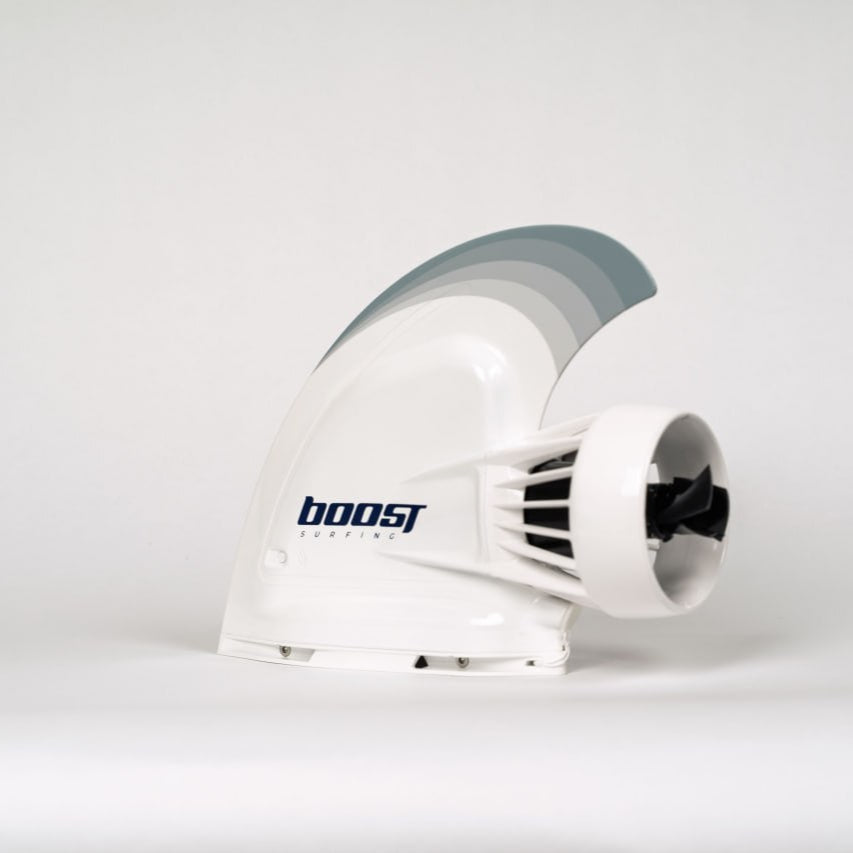
The Boost Fin Plus
A patented electric fin with a self-cleaning folding propeller. Installs in 5 minutes. No drilling. No permanent changes. The motor handles the paddle-out. Your shoulders rest.
The Boost Fin Plus. Retail $599. Fits any standard fin box.
Chapter Five
June 7th, 2025. A Saturday. He woke up at 4:50 — before the alarm. The Boost Fin had been sitting in its box on the kitchen counter for three days. He'd read the manual twice. Watched the installation video four times. Charged the battery overnight.
"I drove to Tourmaline. The parking lot was empty — I was early, even for dawn patrol. My hands were shaking. Not from the cold. I was terrified. Terrified that it wouldn't work. Terrified that it would."
The fin slid into the box in about four minutes. Click, lock, done. It looked strange on his board — a small black fin with a folded propeller. Unassuming. He clipped the remote to his wrist.
He carried the board to the water's edge. The sand was cold. The air smelled like kelp and salt — the same smell from every morning for twelve years.
He pressed the button.
"The motor hummed. Quiet. Like a vibration more than a sound. And the board just... moved. I was on my stomach, arms at my sides, and I was moving through the water. Past the whitewash. Past the break. Out to the lineup. In maybe four minutes."
He pauses again. Longer this time.
"The last time I paddled out there, it took me twenty minutes and my shoulder was on fire by the time I sat up. This time, I got there and I wasn't even breathing hard. My shoulder didn't feel anything. Nothing."

"I sat on my board and watched the sunrise. I hadn't done that in fourteen months. I didn't catch a single wave that first day. I didn't need to."
Chapter Six
He went back the next morning. And the morning after that.
The first week was about relearning. His timing was off — fourteen months out of the water changes your instincts. He missed waves he should have caught. Popped up too late. Fell on takeoffs he used to make with his eyes closed.
"But my shoulder was fine. That was the thing. I could wipe out and paddle back without the fear. The fin took me out. Every time. I could focus on surfing instead of surviving the paddle."
By week two, his timing was coming back. By week three, he was catching three or four waves per session. By week six, he was staying out for ninety minutes.
The regulars noticed. Mike asked about the fin. Carlos, who'd originally told him about it, wanted to try it. Bones — the older guy — ordered one that same week.
"I thought they'd give me shit for it," Tom says. "The motorized-fin guy. But nobody cared. Mike said, 'If it gets you back in the water, what's the problem?' And that was it."
4
mornings per week
back in the water
90
minute sessions
shoulder pain-free
0
paddle strain
on the way out
14
months away
finally over
Chapter Seven
August 23rd, 2025. A south swell — the kind San Diego gets maybe four times a year. Clean, overhead, glassy. Tom checked the forecast the night before and set his alarm for 5:00.
"I got to Tourmaline and the lot was already full. Everyone was there. I pulled the fin out, slid it in, carried my board down. The water was warm — summer warm. That green-blue you only get in August."
He pressed the button and glided out past the break. Sat up. Looked around. The sun was just clearing the hills behind him. He could see La Jolla to the north, Point Loma to the south. Mike was twenty yards to his left. Bones was further out.
And then the set came.
"I caught the second wave. Dropped in, bottom-turned, and the wall just opened up. I was riding. Really riding. Not thinking about my shoulder, not compensating, not protecting anything. Just surfing."
"I rode it all the way to the inside. Kicked out. And I was laughing. Out loud, in the ocean, by myself. Like a kid."
He surfed for two hours that morning. Caught eleven waves. His shoulder felt nothing.
Now
It's January 2026. Tom surfs four mornings a week. The Boost Fin is on his board every session — "non-negotiable," he calls it. His daughter, now nine, has started taking lessons on Saturdays. He paddles her out on a soft-top with the fin doing the work.
He still does physical therapy once a week. His shoulder is functional but not what it was. He knows that. He's made peace with it.
"I'm not the surfer I was at twenty-five," he says. "My pop-ups are slower. I take fewer risks. But I'm in the water. I'm in the water every morning. And that's the thing that matters — not how you get out there, but that you get out there."
The card his daughter made is still on the fridge. The one that says "Get Well Soon." He's thought about taking it down. But he likes seeing it there.
It reminds him.
"The doctor said surfing was behind me. He was a good doctor. But he didn't know about this fin. And he didn't know me."
— Tom Brennan, 38. San Diego, California.
About the Boost Fin Plus
A patented electric fin with a folding propeller that removes up to 90% of shoulder strain during paddle-out. Installs on any board in 5 minutes. 100-minute battery. Waterproof remote with variable speed control.
Free worldwide shipping · 30-day guarantee · 1-year warranty
Get Boost Fin Plus — $599